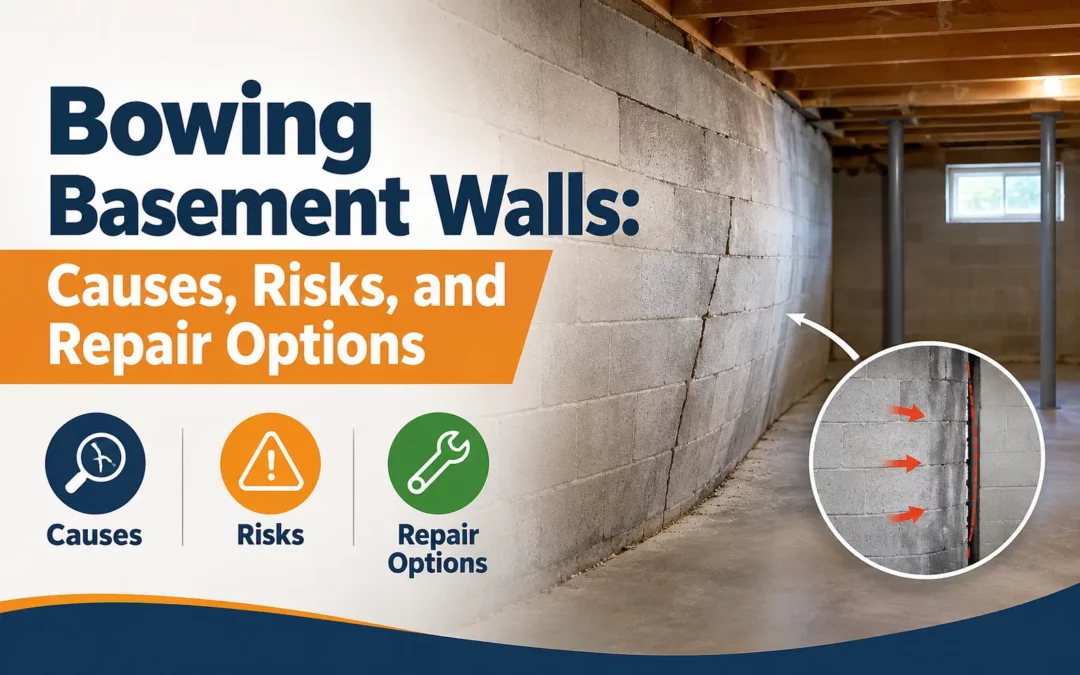
A Bowing basement walls that is curving, bulging, or leaning inward is more than a cosmetic concern. It can indicate that the wall is being subjected to lateral pressure from the soil and moisture outside your home.
The good news is that a bowing basement wall does not automatically mean the entire foundation needs to be replaced. Depending on the wall material, amount of movement, condition of the wall, drainage conditions, and underlying cause, stabilization may be possible with methods such as carbon-fiber reinforcement, steel I-beams, or helical tie-backs.
The important part is determining why the wall is moving and whether the movement is continuing before choosing a repair method.
What Is a Bowing Basement Wall?
A bowing basement wall is a foundation wall that has moved inward from its original position.
Instead of remaining relatively straight and vertical, the wall may:
- Curve or bulge toward the basement
- Lean inward
- Develop long horizontal cracks
- Develop stair-step cracks in masonry
- Show widening or changing cracks
- Allow water to enter through cracks or joints
- Show visible separation or movement around connected areas
Bowing can occur in both concrete block and poured-concrete foundation walls, although the way the damage appears can vary depending on the construction.
A crack by itself does not necessarily mean a wall is bowing. Bowing involves actual movement or deformation of the wall, which is why evaluating the wall as a whole is important.
If you’re also seeing foundation cracks, read our guide to foundation cracks and which ones are serious to understand the difference between common cracks and potentially serious foundation movement.
What Causes Basement Walls to Bow?
The most common underlying problem is lateral pressure from the soil outside the foundation.
Basement walls are designed to resist the forces around them, but changes in soil moisture, drainage, soil conditions, and other factors can increase the pressure against the wall.
1. Water-Saturated Soil
One of the biggest contributors to foundation wall pressure is excess moisture.
When the soil around your foundation becomes saturated, the conditions around the wall change. Water can increase pressure against the foundation and may contribute to movement over time.
This is particularly important after:
- Heavy rainfall
- Prolonged wet weather
- Poor drainage
- Snowmelt
- Water collecting beside the foundation
The relationship between moisture and foundation movement is one reason drainage should be considered when investigating a bowing wall.
2. Hydrostatic Pressure
Hydrostatic pressure is pressure created by water in the soil surrounding a foundation.
If water cannot drain away properly, it can accumulate against basement walls. That additional pressure can contribute to cracking, water intrusion, and inward movement.
Common drainage problems include:
- Gutters dumping water near the foundation
- Downspouts that discharge too close to the house
- Poor grading around the foundation
- Clogged or damaged drainage systems
- Soil that retains significant moisture
- Water collecting around the foundation
Fixing drainage may reduce the source of pressure, but drainage improvements alone do not necessarily straighten a wall that has already moved.
3. Soil Movement
Soil isn’t always stable.
Changes in moisture content, soil composition, compaction, and seasonal conditions can affect the pressure placed against a foundation.
Certain soils can expand when wet and shrink when dry. Repeated changes can place stress on foundation walls over time.
This is particularly important for Virginia homeowners because soil and drainage conditions can vary considerably between different parts of Central and Southern Virginia.
For more information, read our guide to what causes foundation cracks in Virginia homes.
4. Poor Grading and Drainage
The ground around your home should generally direct water away from the foundation.
When the terrain slopes toward the house, rainwater can collect beside the foundation instead of draining away.
Likewise, gutters and downspouts can contribute to foundation moisture if roof runoff is discharged directly beside the basement wall.
Improving exterior drainage can be an important part of addressing the conditions contributing to foundation pressure.
5. Freeze-Thaw Conditions
In colder areas, water in the surrounding soil can freeze and expand.
Repeated freezing and thawing can contribute to soil movement and additional pressure against foundation walls.
The impact depends on local climate, soil conditions, drainage, wall construction, and other site-specific factors.
6. Wall Age, Construction and Existing Damage
The condition and construction of the foundation also matter.
Older masonry walls, deteriorated mortar joints, previous repairs, existing cracks, and other structural weaknesses may affect how a wall responds to external pressure.
That’s why two homes with apparently similar bowing may require completely different repair approaches.
Warning Signs of Bowing Basement Walls?
Some signs are easy to see, while others become noticeable only after the problem has progressed.
Watch for:
Horizontal Cracks
A long horizontal crack running through a basement or foundation wall can be associated with lateral pressure.
It should be evaluated rather than simply patched over, particularly if the crack is changing.
A Wall That Looks Curved
Stand several feet away and look along the wall.
A bowing wall may appear:
- Curved inward
- Bulged near the middle
- Leaning toward the basement
- Uneven compared with adjacent walls
Stair-Step Cracks
Stair-step cracking can occur in masonry walls when the wall is subjected to movement.
The crack pattern matters because different types of foundation movement can create different patterns.
Water Intrusion
Water coming through foundation cracks or wall joints can be an important clue that drainage and moisture conditions need attention.
Learn more about basement waterproofing solutions if water is entering your basement or moisture is repeatedly collecting around your foundation.
Changes Over Time
Movement is especially important.
If a crack becomes larger, the wall becomes visibly more curved, or other symptoms appear over time, don’t assume the problem will correct itself.
Take photographs and document what you see so that changes can be compared.
Are Bowing Basement Walls Dangerous?
A bowing basement wall should be taken seriously, but it is not accurate to assume that every bowed wall means the house is about to collapse.
The actual risk depends on factors such as:
- How much the wall has moved
- Whether movement is continuing
- Foundation wall material
- Crack location and pattern
- Condition of the masonry or concrete
- Soil conditions
- Water and drainage conditions
- Whether the wall has rotated, shifted, or deteriorated
- Whether other parts of the foundation are affected
The biggest mistake is trying to determine the severity from one crack or one measurement alone.
A professional assessment can help determine whether the wall needs monitoring, stabilization, drainage improvements, structural reinforcement, or a more extensive repair.
For additional warning signs, see our guide to signs your foundation needs immediate attention.
How Do You Fix a Bowing Basement Wall?
There is no single repair method that works for every bowing basement wall.
The appropriate solution depends on the condition of the wall and the forces causing the movement.
Common repair options include:
- Carbon-fiber reinforcement
- Steel I-beam supports
- Helical tie-backs
- Drainage and waterproofing improvements
- Foundation wall replacement in severe cases
Here’s how the major approaches differ.
1. Carbon-Fiber Reinforcement
Carbon-fiber reinforcement is a low-profile method that can be used for certain foundation walls with appropriate conditions.
The carbon-fiber material is bonded to the wall and helps resist additional inward movement.
Advantages
- Low-profile installation
- Can often be installed from inside the basement
- Minimal disruption compared with excavation
- Does not require major exterior excavation
- Useful for certain wall conditions
Important Limitation
Carbon fiber is primarily a stabilization solution.
It is important to understand that reinforcing a wall does not necessarily mean the existing bow will disappear. In many applications, the goal is to prevent additional movement rather than return the wall completely to its original position.
Whether carbon fiber is appropriate depends on the wall’s condition and the extent of movement.
2. Steel I-Beam Supports
Steel I-beams can provide structural support against a bowing basement wall.
The beams are installed vertically against the interior side of the foundation wall and secured to the appropriate structural components.
Steel I-beams may be considered when:
- The wall requires stronger interior reinforcement
- The wall has more significant movement
- Exterior access is limited
- The wall’s condition makes a low-profile reinforcement system unsuitable
One trade-off is that the beams remain visible inside the basement and can take up some usable wall space.
Copper Fox Foundation Solutions offers foundation repair and wall reinforcement services for bowing basement walls as part of its foundation repair solutions.
3. Helical Tie-Backs
Helical tie-backs are another option for certain bowing foundation walls.
The system connects the foundation wall to suitable soil outside the structure, helping resist the forces pushing the wall inward.
Potential advantages include:
- External support for the foundation wall
- Ability to address significant lateral forces
- Minimal interior obstruction compared with permanent interior beams
- Potential for controlled correction in appropriate situations
However, the feasibility depends on factors such as available exterior space, soil conditions, property layout, utilities, and the condition of the foundation wall.
4. Drainage and Waterproofing Improvements
Structural reinforcement addresses the wall, but homeowners should also investigate why excessive pressure developed in the first place.
If water is collecting around the foundation, drainage improvements may be part of the overall solution.
Possible measures can include:
- Improving grading
- Correcting downspout discharge
- Improving exterior drainage
- Installing drainage systems
- Addressing basement water intrusion
- Installing or improving sump pump systems
Copper Fox provides basement waterproofing and drainage solutions that can be considered when moisture is contributing to foundation problems.
Important: Drainage improvements can help address the cause of excessive moisture, but they do not automatically straighten a wall that has already bowed.
5. Foundation Wall Replacement
In difficult situations, reinforcement may not be enough.
If a foundation wall has substantial structural deterioration, severe displacement, or other damage that makes stabilization unsuitable, partial or complete wall replacement may need to be considered.
This is generally a much more involved project than reinforcement.
The decision should be based on an evaluation of the actual wall rather than simply how large a crack looks.
Bowing Basement Wall Repair Options Compared
| Repair Method | Main Purpose | Exterior Excavation | Interior Space Impact | Best Determined By |
| Carbon-fiber reinforcement | Stabilize suitable walls | Usually no | Low | Wall condition and movement |
| Steel I-beams | Reinforce and support wall | Usually no | Higher | Wall condition and access |
| Helical tie-backs | Resist lateral pressure | May be required | Low | Soil and property conditions |
| Drainage improvements | Reduce moisture-related pressure | Depends on system | Low–moderate | Water and drainage conditions |
| Wall replacement | Replace severely damaged wall | Typically yes | Project-dependent | Structural condition |
There is no universal rule that says one method is always better than another. The repair should match the actual cause and condition of the wall.
Does Fixing Drainage Stop a Bowing Basement Wall?
Drainage can be an important part of the solution, but it depends on how much movement has already occurred.
For example, correcting a downspout that discharges directly beside the foundation may reduce unnecessary moisture around the wall.
But if the wall has already bowed, simply redirecting the water will not necessarily move the wall back into its original position.
Think of it as two separate questions:
- What caused the pressure?
- What needs to be done to the wall?
A good repair plan should consider both.
Can You Repair a Bowing Basement Wall From the Inside?
In some cases, yes.
Carbon-fiber reinforcement and steel I-beam systems can be installed from inside the basement, depending on the wall and site conditions.
Interior repair can be especially useful when exterior excavation is difficult because of:
- Driveways
- Patios
- Landscaping
- Property lines
- Attached structures
- Limited yard access
However, interior access does not automatically make every repair method appropriate.
The wall should be evaluated before selecting a system.
Should You Try to Fix a Bowing Basement Wall Yourself?
DIY cosmetic repairs are not the same as structural foundation repair.
Painting over cracks, applying patching compound, installing drywall, or sealing visible water entry may hide the symptoms without addressing the underlying movement.
If the wall is visibly bowing, leaning, bulging, or developing significant cracking, it’s better to determine the cause before covering the evidence.
A professional assessment can help identify:
- Whether the wall is actually moving
- Whether the movement is active
- What is causing the pressure
- Whether drainage is contributing
- Which repair options are realistic
- Whether additional foundation areas should be evaluated
What Should You Do If You Notice a Bowing Basement Wall?
If you suspect your basement wall is bowing, take a few practical steps.
1. Take Clear Photos
Photograph the entire wall as well as close-ups of cracks and damaged areas.
2. Document Changes
Keep track of any visible changes over time.
If you notice new cracks or changes in existing cracks, record when they appeared.
3. Check Exterior Drainage
Look at:
- Gutters
- Downspouts
- Grading
- Standing water
- Areas where water collects near the foundation
You can also review our guide to how gutters can cause foundation problems to understand how roof runoff can contribute to moisture and soil pressure.
4. Don’t Cover the Problem
Avoid installing finished walls or making cosmetic repairs before the underlying condition has been evaluated.
5. Schedule an Assessment
A professional foundation evaluation can help determine whether you need stabilization, structural reinforcement, drainage improvements, or a more extensive solution.
For homeowners dealing with broader foundation movement or structural concerns, Copper Fox also provides foundation repair services in Central and Southern Virginia.
How Much Does Bowing Basement Wall Repair Cost?
There is no reliable single price for repairing a bowing basement wall.
The final cost can vary based on:
- Length of the affected wall
- Foundation type
- Amount of movement
- Wall condition
- Repair method
- Number of reinforcement points
- Soil conditions
- Exterior access
- Drainage requirements
- Additional foundation damage
For that reason, online cost ranges should be treated cautiously.
Two homes with similar-looking bowing can require very different solutions.
The best way to understand the cost is to have the wall evaluated and receive a repair recommendation based on the actual conditions at the property.
How to Prevent Bowing Basement Walls
You cannot control every soil or site condition around your home, but good water management can help reduce unnecessary stress on the foundation.
Keep Gutters Clear
Clogged gutters can cause roof water to overflow directly beside the foundation.
Direct Downspouts Away From the Foundation
Downspouts should not dump large amounts of roof runoff immediately beside the basement wall.
Maintain Proper Grading
Watch for areas where the ground slopes toward the house or where water repeatedly collects.
Monitor Basement Moisture
Pay attention to:
- Damp walls
- Water stains
- Musty odors
- Recurring puddles
- Cracks that allow water to enter
Monitor Existing Foundation Problems
If you’ve already noticed cracking or movement, document changes rather than assuming the condition is stable.
For a more complete maintenance routine, follow our foundation maintenance checklist.
Bowing Basement Walls in Virginia
Virginia homeowners can encounter different soil, drainage, terrain, weather, and construction conditions depending on where the home is located.
A foundation problem in Richmond may not have exactly the same cause as a problem in Lynchburg, Charlottesville, Harrisonburg, Roanoke, or another Central or Southern Virginia community.
That is why a useful foundation evaluation should consider the whole property, including:
- Foundation construction
- Wall material
- Soil conditions
- Drainage
- Grading
- Water intrusion
- Visible cracking
- Wall movement
- Previous repairs
Copper Fox Foundation Solutions serves homeowners throughout Central and Southern Virginia and provides foundation repair and stabilization solutions based on the conditions of the property.
Frequently Asked Questions About Bowing Basement Walls
Can a bowed basement wall be fixed?
Yes, many bowed basement walls can be stabilized or repaired. The appropriate method depends on the wall material, degree of movement, structural condition, soil pressure, drainage, and accessibility.
What is the main cause of bowing basement walls?
Bowing is generally associated with lateral pressure from the surrounding soil. Excess moisture, saturated soil, drainage problems, soil movement, and other site conditions can increase the pressure against a foundation wall.
Are bowing basement walls serious?
They can be. A bowed wall indicates that the wall has moved from its original position, so it should be evaluated rather than treated as a purely cosmetic problem. The actual level of risk depends on the wall’s condition and whether movement is continuing.
Can water cause basement walls to bow?
Water can contribute to the conditions that cause bowing. Saturated soil and hydrostatic pressure can increase the lateral forces acting against a basement wall.
Will fixing drainage straighten a bowed wall?
Not necessarily. Improving drainage can reduce moisture-related pressure, but a wall that has already moved may require structural stabilization or another repair method.
Is carbon fiber good for bowing basement walls?
Carbon fiber can be an effective stabilization method for certain foundation walls. However, it is not appropriate for every situation and generally stabilizes the wall rather than automatically straightening existing movement.
Are steel I-beams better than carbon fiber?
Neither is universally better. The appropriate choice depends on the wall’s condition, amount of movement, access, structural requirements, and repair objectives.
Can a bowing basement wall be repaired from inside?
Often, yes. Certain carbon-fiber and steel reinforcement systems can be installed from the interior. Whether interior repair is appropriate depends on the condition and configuration of the wall.
Should I cover a bowing basement wall with drywall?
It is better to have the wall evaluated first. Covering the wall can make it more difficult to monitor cracks, moisture, or continuing movement.
Does a bowing basement wall mean my house will collapse?
No. A bowing wall does not automatically mean the house is going to collapse. However, it is a structural condition that deserves proper evaluation so the cause and appropriate repair can be determined.
Concerned About a Bowing Basement Wall?
A bowing basement wall is not something you should diagnose based on a single crack or an online photo.
The important questions are what is causing the pressure, whether the wall is still moving, and which repair method is appropriate for the wall’s actual condition.
Copper Fox Foundation Solutions provides foundation repair, stabilization, and basement waterproofing solutions for homeowners throughout Central and Southern Virginia.
If you’ve noticed a bowing, bulging, or leaning basement wall, don’t wait until the symptoms become harder to evaluate.
Contact Copper Fox Foundation Solutions to request a free foundation estimate and have your foundation concerns professionally evaluated.