
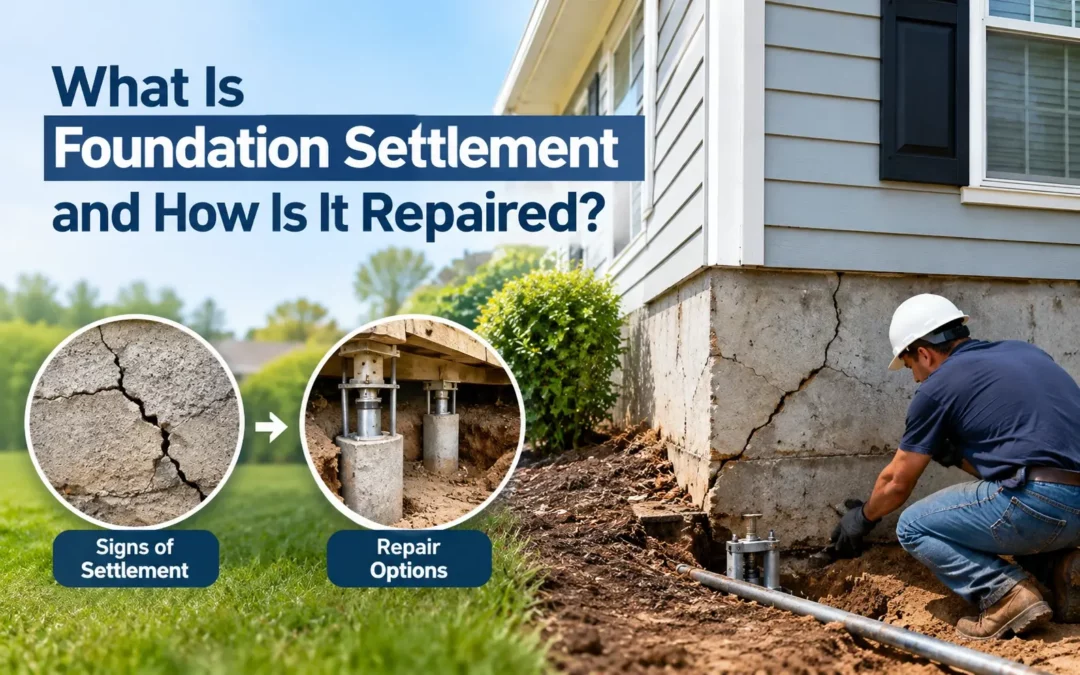
Foundation settlement is the downward movement of a home’s foundation into the soil supporting it. Some settlement can occur as a home and its soil adjusts. Still uneven or continuing movement, called differential settlement, can cause cracks, sloping floors, sticking doors and windows, gaps, and other structural problems. Foundation settlement repair depends on what caused the movement, whether it is still active, and how the foundation is supported.
Foundation settlement does not automatically mean a home needs a new foundation. In many situations, the appropriate solution is stabilization or underpinning of the affected area rather than complete foundation replacement.
The key is determining why the foundation settled before choosing a repair method.
For homeowners throughout the United States, including Virginia, this distinction matters because settlement can result from different soil, drainage, construction, moisture, and structural conditions.
What Is Foundation Settlement?
Foundation settlement occurs when the soil beneath or supporting a home’s foundation compresses, shifts, erodes, or otherwise changes enough for part of the foundation to move downward. A house places substantial weight on the soil beneath it. If that soil does not provide consistent support, the foundation can settle. Not all settlement is the same.
Uniform Settlement
Uniform settlement occurs when the foundation moves downward relatively evenly.
Some movement can occur as a new structure places its weight on the supporting soil and the soil adjusts.
When movement is relatively uniform and stabilizes, it may create fewer structural problems than uneven movement.
Differential Foundation Settlement
Differential settlement occurs when different sections of a foundation move downward by different amounts or at different rates.
For example, one corner of a house may settle while another section remains relatively stable.
That difference can place stress on the structure above the foundation.
This is why differential settlement in foundations is an important question for homeowners. The problem is not simply that the house moved downward; it is that different parts of the structure moved differently.
Possible results include:
- Foundation settlement cracks
- Sloping floors
- Uneven floors
- Sticking doors
- Sticking windows
- Gaps around doors and windows
- Cracks in drywall or masonry
- Separation around additions
- Other changes in the structure
Current US guidance similarly distinguishes uniform settlement from differential movement because uneven movement is more likely to distort the structure.
What Causes Foundation Settlement?
There is no single cause of foundation settlement.
The soil beneath a home, water conditions, drainage, construction history, foundation design, and structural loads can all play a role.
The most common causes include:
- Soil consolidation
- Poorly compacted fill
- Soil moisture changes
- Poor drainage
- Soil erosion
- Weak or compressible soil
- Plumbing or water-related problems
- Changes to the property or structure
- Long-term movement in older homes
Let’s look at each one.
1. Soil Consolidation
Soil can compress under the weight of a home.
If the soil beneath a foundation continues consolidating after construction, the foundation above it can move downward.
The amount of movement depends on the type of soil, its condition, the foundation design, and the loads placed on it.
2. Poorly Compacted Fill Soil
Fill soil is sometimes placed during site preparation or grading.
If fill is not properly compacted, it may compress after construction as the weight of the home is transferred to it.
This can result in localized or differential settlement.
This is one reason the construction history of a property can be important when investigating foundation movement.
3. Soil Moisture Changes
Changes in soil moisture can affect how some soils behave.
Certain clay soils can shrink when they lose moisture and expand when they absorb water. If moisture conditions vary significantly beneath different sections of a home, the resulting soil movement can contribute to differential foundation movement.
This does not mean every home with clay soil will develop settlement.
The actual soil profile and site conditions matter.
For more information about how local soil conditions affect residential foundations, read what causes foundation cracks in Virginia homes.
4. Poor Drainage
Water management around the home is another important factor.
Problems such as:
- Poor grading
- Downspouts discharging too close to the foundation
- Standing water
- Surface runoff
- Drainage failures
can alter soil moisture around the foundation.
When investigating settlement, it is therefore important to look at the foundation and the conditions around it.
Learn more about how gutters can cause foundation problems and why managing roof runoff matters.
5. Soil Erosion
Water can sometimes wash soil away from areas supporting a foundation.
If enough supporting material is lost, the foundation may lose part of its bearing support and settle.
Erosion is particularly important to investigate when settlement occurs near concentrated water flow.
Read this related guide on how soil erosion can damage your home’s foundation for more information.
6. Weak or Compressible Soil
Some soils are more compressible than others.
If the supporting soil cannot adequately handle the load of the structure, the foundation may gradually move downward.
The resulting settlement can be uniform or differential depending on how the soil conditions vary beneath the home.
7. Plumbing or Water-Related Problems
Water from a leaking plumbing line can alter soil conditions beneath or near a foundation.
In some situations, excessive moisture can cause soil expansion or loss of supporting material. The resulting movement can sometimes be mistaken for other forms of foundation settlement.
This is why plumbing and drainage conditions can be relevant during an investigation.
8. Changes to the Property or Structure
Changes made after a home was constructed can sometimes affect soil, drainage, or structural loads.
Examples include:
- Home additions
- Major remodeling
- Changes in grading
- New drainage patterns
- Landscaping changes
- Plumbing modifications
- Changes to structural load paths
These conditions do not automatically cause foundation settlement, but they can be relevant when determining why movement developed.
9. Long-Term Movement in Older Homes
Older homes may have experienced years of settlement, remodeling, additions, drainage changes, and structural modifications.
An older house having some unevenness does not automatically mean it has an active foundation problem.
The more important question is whether the condition is stable or changing.
What Are the Signs of Foundation Settlement?
Foundation settlement can produce symptoms throughout a house.
Common foundation settlement signs include:
- New or changing foundation cracks
- Diagonal cracks near doors or windows
- Stair-step cracks in masonry
- Sloping floors
- Uneven floors
- Doors that stick
- Windows that become difficult to open
- Gaps around doors and windows
- Gaps between walls and ceilings
- Gaps between walls and floors
- Separation around an addition
- Visible movement of foundation components
However, a single symptom does not prove that foundation settlement is occurring.
For example, a sticking door can result from normal seasonal movement, humidity, or framing changes.
Likewise, a sloping floor can be caused by damaged floor joists or beams rather than a settling foundation.
The pattern and combination of symptoms are much more useful than one isolated sign.
For homes with raised foundations and crawl spaces, pier and beam foundation problems can also cause uneven floors, sticking doors, and other symptoms that resemble foundation settlement.
What Do Foundation Settlement Cracks Look Like?
Foundation settlement cracks can appear in different patterns depending on how the structure has moved.
Possible patterns include:
Diagonal Cracks
Diagonal cracks may develop near corners of doors and windows when different parts of a structure move.
Stair-Step Cracks
Stair-step cracking can occur in brick or masonry when sections of the structure move differently.
Vertical Cracks
Vertical foundation cracks can have multiple causes and do not automatically indicate settlement.
Horizontal Cracks
Horizontal cracks can be associated with lateral pressure or other structural conditions and should not automatically be classified as settlement cracks.
The appearance of a crack alone is not enough to diagnose foundation settlement.
The location, direction, age, change over time, surrounding conditions, and other symptoms should all be considered.
If the main concern is a particular crack, Copper Fox’s guide on whether foundation cracks are serious provides more focused information.
How Can You Tell If Foundation Settlement Is Active?
One of the most important questions in a settlement investigation is whether the foundation is still moving.
A homeowner may have a crack or floor slope that has existed for many years without significant change.
Another homeowner may have a recently developing problem.
Potential signs of ongoing movement include:
- Cracks that are getting longer or wider
- New cracks appearing
- Doors becoming progressively harder to close
- Windows becoming increasingly difficult to operate
- Floor slopes becoming more noticeable
- New gaps developing
- New masonry separation
- Changes occurring in multiple areas of the house
Monitoring can help document changes, but it does not replace an evaluation when significant structural movement is suspected.
Current settlement guidance increasingly emphasizes determining what moved, how much it moved, and whether there is evidence of active movement before selecting a repair.
Is Foundation Settlement Normal?
Some foundation settlement can be normal, particularly when a new home initially adjusts to the supporting soil. The greater concern is uneven, excessive, or continuing settlement.
A stable condition is different from active differential movement.
For example:
Stable condition:
A slight floor slope has existed for many years without noticeable change.
Potentially active condition:
A floor has recently become more uneven while new cracks and sticking doors have also appeared.
The second situation deserves closer evaluation.
The age of the house alone cannot determine whether settlement is serious.
How Is Foundation Settlement Diagnosed?
Before deciding how to repair foundation settlement, the cause and extent of movement should be investigated.
A useful evaluation considers several factors.
1. Document the Symptoms
Record:
- Where cracks are located
- When they were first noticed
- Whether they have changed
- Which doors or windows are sticking
- Where floors appear uneven
- Whether the problem affects one room or several
Photos with dates can help document changes.
2. Examine the Foundation
The foundation should be inspected for:
- Cracking
- Displacement
- Settlement patterns
- Loss of support
- Changes around footings or piers
3. Examine the Structure
The inspection should not stop at the foundation.
Depending on the home, relevant areas can include:
- Floor framing
- Beams
- Posts
- Crawl spaces
- Basement walls
- Slabs
- Masonry
This helps distinguish foundation movement from problems originating in the structure above or below it.
4. Evaluate Drainage
Look for:
- Standing water
- Poor grading
- Downspouts near the foundation
- Concentrated runoff
- Plumbing leaks
- Signs of erosion
5. Consider Soil Conditions
The type and condition of the supporting soil can influence the appropriate repair method.
The same visible symptom can have different causes on two different properties.
6. Determine Whether Movement Is Active
The final question is whether the condition is stable or continuing.
That distinction can influence whether monitoring, maintenance, structural repair, stabilization, or another approach is appropriate.
Homeowners can also use this foundation maintenance checklist to identify drainage concerns and changes that may warrant further investigation.
How to Fix Foundation Settlement
How to fix foundation settlement depends on the cause, location, severity, foundation type, soil conditions, and whether movement is continuing.
There is no universal foundation settlement repair method.
Possible solutions include:
- Drainage correction
- Soil-related corrections
- Structural framing repairs
- Foundation underpinning
- Helical piers
- Push piers
- Slab piers
- Concrete piers
- Spot piers
- Other foundation stabilization systems
The correct repair should address the underlying cause rather than simply covering up the visible symptom.
Foundation Settlement Repair Methods
Foundation Stabilization
Foundation stabilization is designed to provide additional support to a foundation experiencing movement.
The stabilization system should be selected according to the home’s foundation type, soil conditions, location of settlement, structural loads, and other site-specific factors.
Copper Fox provides foundation stabilization and pier installation for homeowners dealing with settlement and other foundation movement.
Helical Piers
Helical piers are steel support systems installed into the ground beneath or adjacent to a foundation.
They can transfer structural loads to suitable supporting soil at greater depth.
Whether helical piers are appropriate depends on the property and the conditions found during evaluation.
Push Piers
Push piers are steel piers advanced into the ground beneath an affected foundation.
They can transfer structural loads through weaker near-surface soils toward stronger supporting material.
They are not automatically appropriate for every settlement problem.
Slab Piers
Homes built on slab foundations can require specialized support systems.
Slab piers can be used in certain situations to provide additional support beneath affected areas.
Concrete or Spot Piers
Localized settlement may sometimes be addressed using concrete or spot pier systems.
These are situation-specific solutions and should be selected based on the actual structural and soil conditions.
Structural Repairs
Sometimes the apparent settlement problem originates in:
- Beams
- Joists
- Posts
- Crawl-space supports
- Other structural components
In such cases, repairing the affected structure may be more appropriate than installing foundation piers.
This is an important distinction because not every sloping floor is a foundation problem.
For settled exterior concrete, such as a sidewalk or patio beside the house, concrete leveling services may be relevant. Concrete leveling and structural foundation settlement repair are different issues, so the cause should be evaluated before choosing a solution.
Can Foundation Settlement Be Repaired Without Replacing the Foundation?
Yes. Foundation settlement does not automatically require complete foundation replacement.
Depending on the situation, the affected section may be stabilized or underpinned.
Potential solutions can include:
- Helical piers
- Push piers
- Slab piers
- Concrete piers
- Localized structural support
- Drainage improvements
- Structural framing repairs
The appropriate solution depends on the cause.
A homeowner should not assume that the most extensive repair is automatically the best repair.
Can Foundation Settlement Be Fixed Permanently?
The goal of foundation settlement repair is generally to stabilize the affected structure and address the conditions responsible for movement.
However, homeowners should be cautious about contractors who promise that every settled foundation can simply be returned to its exact original position.
In many situations, stabilization is more important than trying to restore every part of the structure to its original elevation.
The appropriate objective depends on:
- The extent of movement
- Structural condition
- Foundation type
- Soil conditions
- Repair method
- Whether movement is active
How Much Does Foundation Settlement Repair Cost?
The cost of foundation settlement repair varies widely.
Factors that can affect the cost include:
- Cause of settlement
- Foundation type
- Number of affected areas
- Soil conditions
- Repair method
- Number of piers or supports required
- Accessibility
- Drainage work
- Additional structural repairs
Because foundation settlement repair cost is a separate high-intent search query, Copper Fox should keep detailed pricing information on its dedicated cost page rather than duplicating it here.
See the foundation repair cost guide for more information.
This helps this article remain focused on the primary search intent: what foundation settlement is and how it is repaired.
Can Foundation Settlement Get Worse Over Time?
It can, but not every settlement condition continues to worsen.
Some settlement may stabilize after the soil reaches a more stable condition.
Other cases can remain active because of:
- Continuing soil movement
- Drainage problems
- Moisture changes
- Erosion
- Poor supporting soil
- Ongoing structural loads
That is why homeowners should not assume either:
“It will definitely get worse.”
or:
“It has been there for years, so it doesn’t matter.”
The better question is whether there is evidence of ongoing movement.
What Happens If Foundation Settlement Is Ignored?
An active settlement problem can affect more than the foundation itself.
Continued movement can contribute to:
- Increasing cracks
- Uneven floors
- Sticking doors and windows
- Masonry damage
- Gaps
- Structural distortion
- Damage to connected building components
Not every settlement problem becomes severe, but homeowners should understand the condition before deciding to simply monitor it.
For additional guidance, read five warning signs your foundation needs immediate attention.
How to Prevent Foundation Settlement
You cannot eliminate every possible cause of foundation movement, but homeowners can reduce certain risks.
Maintain Drainage
Make sure water is directed away from the foundation rather than collecting next to it.
Monitor Grading
Watch for areas where the ground slopes toward the house.
Manage Downspouts
Downspouts should not concentrate large amounts of roof runoff directly against the foundation.
Address Plumbing Leaks
Water beneath or beside the foundation can affect soil and structural conditions.
Watch for Changes
Pay attention to new cracks, changing floors, sticking doors, or other new symptoms.
Maintain the Area Around the Home
Avoid allowing drainage or landscape changes to create persistent moisture problems around the foundation.
These steps cannot guarantee that settlement will never occur, but they can help homeowners identify and address contributing conditions earlier.
Foundation Settlement in Virginia
Foundation settlement is a nationwide issue, but Virginia homes can have very different foundation conditions depending on location, soil, terrain, drainage, construction type, and age.
Central and Southern Virginia include a wide range of residential properties, from newer construction to older homes that may have undergone additions and structural modifications.
For that reason, there is no single “Virginia foundation settlement” solution. If you are searching for expert help with foundation settlement near me, it helps to know that a home in Lynchburg may have different site conditions from a home in Richmond, Charlottesville, Harrisonburg, or Roanoke.
The repair should be based on the specific property, not simply its location.
Copper Fox Foundation Solutions serves homeowners throughout Central and Southern Virginia with foundation repair and stabilization services.
Frequently Asked Questions About Foundation Settlement
What is foundation settlement?
Foundation settlement is the downward movement of a home’s foundation into the soil supporting it. Some settlement can occur naturally, but uneven or continuing movement can affect the structure.
What causes foundation settlement?
Foundation settlement can result from soil consolidation, poorly compacted fill, soil moisture changes, poor drainage, erosion, weak soil, plumbing-related moisture, and changes to the property or structure.
How do you fix foundation settlement?
How to fix foundation settlement depends on its cause. Potential solutions include drainage correction, structural repairs, underpinning, helical piers, push piers, slab piers, concrete piers, and other stabilization methods.
What are foundation settlement cracks?
Foundation settlement cracks are cracks that may develop as different sections of a structure move. However, not every foundation crack is caused by settlement, so the crack pattern and surrounding conditions need to be evaluated.
Can foundation settlement be repaired without replacing the foundation?
Yes. Many settlement conditions can be addressed through stabilization or underpinning without completely replacing the foundation.
How much does foundation settlement repair cost?
The cost varies depending on the foundation, cause, soil conditions, repair method, number of affected areas, and accessibility. See Copper Fox’s dedicated foundation repair cost guide for more information.
Final Takeaway
Foundation settlement is the downward movement of a home’s foundation into its supporting soil. While some settlement can be normal, differential or continuing settlement can affect the structure and produce cracks, sloping floors, gaps, and sticking doors or windows.
The right foundation settlement repair is determined by the cause—not simply by the most visible crack or symptom.
Before choosing a repair, homeowners should determine:
- What moved?
- Why did it move?
- Is it still moving?
- What type of support does the home need?
Depending on the property, the solution may involve drainage correction, structural repairs, underpinning, helical piers, push piers, slab piers, concrete piers, spot piers, or another stabilization method.
If you’re concerned about foundation settlement in your Virginia home, learn about Copper Fox Foundation Solutions’ foundation stabilization services and request an evaluation to determine what is actually causing the movement.